

Bunny hopping in dogs: what it means, and what to do this week
Owners often mention it almost in passing: their dog runs with both back legs together, like a rabbit, rather than one after the other. It is well worth mentioning, because bunny hopping sits on the veterinary list of arthritis signs, and in a young dog it can be one of the earliest clues that the hips are not quite right. This page covers what it means and what is useful to do this week.
Book an appointment →
The short answer
An occasional hop at full speed is usually nothing, and a dog doing it regularly is worth an unhurried look.
Bunny hopping is a dog using both back legs as one unit rather than moving them separately, and it is a recognised sign of joint disease that often shows up well before any limp does. Plenty of dogs do it now and then at speed and are perfectly fine. If your dog is doing it regularly, or doing it more than they used to, we would like to have a look at their hips and knees.
What does bunny hopping actually look like?
It is easiest to see when your dog is running away from you. In a normal gallop the back legs land slightly apart, one a fraction ahead of the other, while a bunny hopping dog brings both back feet forward and down together, so the back end rises and falls as one piece.
You may also see it on stairs, taking two at a time with both back legs together, or coming out of a sit with a small jump rather than a push.
It is worth being fair about this, because lots of dogs bunny hop now and then, particularly puppies at full speed and particularly on a slippery floor or up a steep hill. What we care about is whether it has become their normal way of moving, and whether it is happening more than it used to.
Why does it matter?
Because a dog will often move both back legs together when using them separately hurts, or when one joint will not extend properly. It is very rarely a stylistic choice, and much more often a dog quietly protecting something, which is exactly why we would like to see it early.
Bunny hopping is one of the recognised signs of arthritis in dogs. The others are:
- A stiff gait, front or back
- A waddle, or the body swaying as they walk
- Not jumping onto furniture or into the car
- Sitting oddly, with a leg straight out or flopped onto one hip
- Trouble getting up from lying down
- Doing less than they used to
The list matters more than any single sign on it. If your dog is doing two or three of these things, we would want to look properly rather than put it down to a quirk.
Is this hip dysplasia?
It is the reason we would want to look at the hips, yes, though it is only one of several possibilities. Hip dysplasia is instability in the hip joint that develops as a dog grows.
Several things feed into it, but genetics is the biggest single risk factor. Putting on weight fast, or growing fast on too much food, makes it worse. It turns up most often in large breeds.
Some of the other signs you might see are limping, not wanting to get up or jump, weight shifted onto the front legs, muscle loss over the back legs, and soreness around the hips. That third one is easy for anyone to miss, because a dog whose back end hurts will carry more weight on the front and can end up simply looking front-heavy and light behind.
Here is what makes an early sign so worth having. Signs can show at any stage, and many dogs with hip dysplasia show none at all, so a dog who is bunny hopping and otherwise happy is not necessarily a dog with nothing going on. They may simply be a dog whose one visible sign you were kind enough to notice, and noticing it is genuinely useful to us.
What else could it be?
Hips are the first thing we think of, but never the only thing, because a dog who is sore in both knees can also stop using the back legs separately. Knee problems are often two-sided, and around half of dogs who do a cruciate ligament in one knee will go on to do the other.
So an examination covers hips, knees and the lower back, on both sides, whatever the owner came in worried about. There is more on the kneecap at luxating patella.
The one thing we would gently steer you away from is settling on arthritis and buying supplements before anyone has looked. Other conditions can look very much like arthritis, so we would rather find out what we are actually treating first, and then help you spend your money on the thing that will help.
Will hydrotherapy help?
We recommend a consultation first, so that we can establish what is causing the bunny hopping. Hip disease will often benefit significantly from hydrotherapy. However, if there are knee issues, surgery is often needed to correct the stability of the knee before we see the benefits of hydrotherapy. There is more on what it involves at hydrotherapy for dogs.
What should I do this week?
- A short video, if you can catch one. Thirty seconds of your dog running away from the camera on flat ground, and thirty seconds of them getting up from lying down. It is honestly the single most useful thing anyone brings us.
- How they sit. Does your dog sit square, or flop onto one hip with a leg out to the side? Either answer tells us something.
- What has changed, as much as what is happening now. Slower on walks, less keen on the car, sleeping more. You know your dog better than anyone, and that comparison is information we cannot get ourselves.
- A look at those legs while it is still just a hop. We can usually fit that in without any fuss.
Better now than once the limp arrives
We would far rather see this now than once the limp has arrived, because spotting a loose joint early is what protects the cartilage while there is still cartilage to protect. Arthritis is painful, and the longer that pain goes untreated the worse it tends to get.
A bunny hop is easy information to act on, and acting early is usually the version of this story where your dog gets more good years out of those legs. What we do next depends entirely on what we find on the day, and we will go through it with you plainly, including what any next step would cost, before anything goes ahead. We do orthopaedic surgery here at Macquarie Park, and we see emergencies during our opening hours.
Book an appointment →We have lots of fur babies and been taking our dogs here for years, they are amazing. All the vets and the staff here are so friendly and knowledgeable. They are also Fear-free certified too which means they take extra time and care with your precious little ones.
Angelico Cruz, Google review · 5 stars
A real review, quoted as written. Read our Google reviews →
Common questions
My puppy bunny hops when he is excited. Is that normal?
Often, yes. Plenty of puppies do it at full speed and grow out of it. Unless it has become their usual way of moving, it is the sort of thing we are happy to look at when you next come in for vaccinations rather than asking you to make a separate appointment.
My dog is not in any pain though.
Dogs hide it very well, and quietly changing how they move is one of the ways they do it, so this is not something you would have missed. Many dogs with hip dysplasia show no obvious signs at all.
Did I cause this by exercising him too much as a puppy?
Almost certainly not, and please do not carry that one around. Genetics is the biggest single factor in hip dysplasia. Fast growth and overfeeding can both contribute, but the great majority of owners have not caused this, and noticing it is the useful thing you have done.
Should I stop walking my dog?
No, and please do not. Steady walks on a lead are good for those joints. We would just ease off the jumping and the ball chasing until we have had a look, and it helps us enormously if you can tell us what seems to make it worse.
What happens at the appointment?
We will watch your dog move, at their pace, and then gently examine the hips, knees and back on both sides. Our other guides on joints sit under orthopaedic surgery for dogs.
Our approach to canine joint disease follows the standards of the American College of Veterinary Surgeons.
References
- American College of Veterinary Surgeons: Osteoarthritis in Dogs Bunny hopping listed among the clinical signs of canine osteoarthritis.
- American College of Veterinary Surgeons: Canine Hip Dysplasia Causes, signs, that many affected dogs show none, and that early recognition is what protects the cartilage.
- American College of Veterinary Surgeons: Cranial Cruciate Ligament Disease How often cruciate disease becomes a two-sided problem.
- RSPCA Australia Knowledgebase: I think my dog has arthritis, what can I do? That untreated pain worsens, and that other conditions mimic arthritis.
Drafted July 2026. This page is general information and cannot replace someone examining your dog.
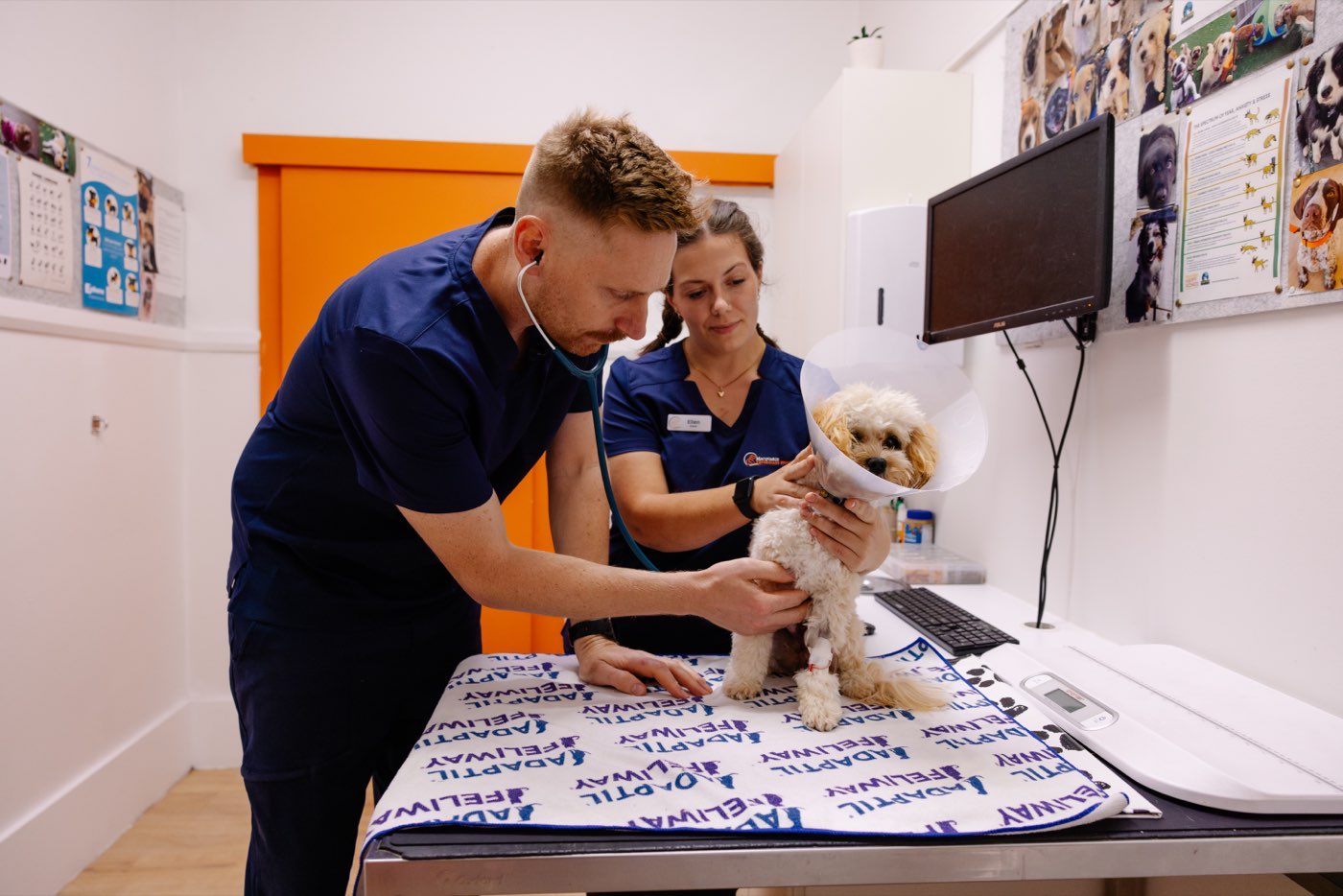
Medically reviewed by Dr Michael Stephen, BVSc, MVSc.
An unhurried look at those back legs
Bring the video if you have one. We will watch your dog move, examine the hips and knees on both sides, and tell you honestly whether we are looking at a habit or a joint, and what any next step would involve. On-street parking on Jarvis Circuit, or the multi-storey car park underneath Coles, accessed from Halifax Street. You can ring us on 02 9888 1833 if you would rather talk it through first.
Book an appointment →