

Dog diarrhoea: when to worry, and when it can wait
Most loose stool in an otherwise bright dog settles within a couple of days, so this is usually a worry that comes to nothing. A small amount of it does not settle, and the difference is not subtle once you know what to look at, which is what we would like to help you with here.
Book an appointment →
The short answer
Here is the plain version, so you can decide.
If your dog is bright, drinking, still interested in you and the only problem is loose stool, it is reasonable to feed something plain and keep a quiet eye on things for a day or two. We would want to hear from you the same day if the diarrhoea lasts more than 48 hours, if there are constant accidents, if your dog stops eating, goes flat, starts vomiting as well, or if the stool is black or tarry. Red, bloody diarrhoea is different: that is an emergency, so please ring straight away. With puppies and older dogs we would rather hear sooner than that.
When we would much rather hear from you today
- Red, bloody diarrhoea, which is a medical emergency, so please ring straight away
- Your dog has stopped eating, or has gone quiet and flat
- Vomiting as well as the diarrhoea, especially if they cannot keep water down
- Black or tarry stool, which is digested blood rather than fresh blood
- It has lasted more than 48 hours, or there are constant accidents. We can give treatment to help it settle faster
- A puppy, particularly one under six months or not yet fully vaccinated
- An old dog, or a dog with an existing health problem
- You think they have eaten something they should not have, including a cooked bone, a toy, rubbish or anything from the garden shed
- A painful, tense or swollen belly, or a dog that will not settle
During opening hours we are on 02 9888 1833, and it helps if you can describe what you are seeing. We would much rather talk you through something that turns out to be nothing. Outside our hours we refer to our after-hours emergency partner, listed in the footer.
How long should dog diarrhoea last?
Usually a day or two, because most cases are mild and settle on their own without any help from us.
We would want to hear from you if your dog stops eating, goes flat, starts vomiting too, passes black or tarry stool, has constant accidents, or is still loose after 48 hours. If the diarrhoea is red and bloody, please ring straight away.
That is the point to pick up the phone rather than a safe window to wait out, and if your dog looks unwell at any point before it, we would rather hear from you then.
Is it normal for a dog to get diarrhoea?
More normal than most owners think. About one dog in twelve is seen for it each year.
The outcomes are reassuring too. More than eight in ten never need a second visit, and almost all are over it within a fortnight of being seen.
Age shifts the odds, and dogs under three and dogs over nine get it more often than dogs in the middle, which matches what we see. A young dog eats things, and an older dog has less in reserve when something goes wrong, so with both of those we would rather hear from you sooner.
What can you do at home to help?
- Water in front of them at all times. Diarrhoea takes fluid out faster than most owners realise, and a dog who is also vomiting loses it faster again.
- Something plain and easy to eat. Boiled chicken or lean mince with white rice suits most dogs, in small portions and more often than usual.
- The extras can pause for a few days. No treats and no rich food until the stool is normal again, and that includes the chew somebody kindly gave them at the park.
- Chicken and rice is a few days of first aid rather than a diet, because bland food is not balanced enough to live on, so we would move them back to normal food once things settle.
- Please do not give human medicines. Not anti-diarrhoeals, not painkillers, not anything from your own cupboard, and a quick call to us first is always welcome.
- A photo, and a sample if you can manage one. Loose stool looks rather different by the time you get here.
If your dog was fine, then changed food, and now has soft stool, then going back to the old food and making the switch again far more slowly usually does it. That one is common and it tends to fix itself.
What causes diarrhoea in dogs?
Most of it is what a dog ate, or a sudden change in what a dog ate. Beyond that, the usual suspects around here are:
- Something scavenged. Rubbish, compost, a dead thing at the reserve, or food that has been out in the sun.
- Cooked bones. Please never give one. They splinter, and the pieces can block or tear the gut.
- Intestinal worms. Often with no other sign at all. Some dogs with whipworm show nothing. Others get on-and-off soft stool with blood or mucus in it.
- Stress. Boarding, a house move, fireworks, a new dog in the family. It is genuinely a cause and not an excuse, and dogs feel these things more than we give them credit for.
- Something toxic. If you think that is possible at all, we would want to hear from you. The Australian Animal Poisons Helpline is a free service for Australian owners and answers around the clock.
- An illness that has nothing to do with the gut. Diarrhoea is a symptom, not a diagnosis, which is exactly why the dog that is also flat and off food needs to be seen.
My dog has diarrhoea and is vomiting. Is that worse?
It is the most common combination, and it dries a dog out fastest. Close to half of dogs with sudden diarrhoea are vomiting as well, so it is not rare.
It is still the combination we most want to hear about, because fluid is going out both ends and none of it is going in.
If your dog cannot keep water down, we would rather see them today than tomorrow, and the same goes for a dog who has gone off their food as well.
There is blood in it. How worried should I be?
Blood in loose stool is more common than you would guess, and it shows up in close to a third of cases. That does not make it nothing, and it is horrible to see, but a streak or a drop of it is not the deciding factor on its own.
What matters is how much, and which kind. Red, bloody diarrhoea is a medical emergency, so please ring straight away. A streak or a drop of red blood is less urgent, but we want to hear about it if it happens more than once or the diarrhoea keeps going. Black tarry stool means something different again: it is digested blood from higher up, so please give us a ring first.
My puppy has diarrhoea. Is that different?
Yes. This is the one place on the page where we would rather you were quick. Puppies dry out fast, and parvovirus is still very much here, with more than 20,000 cases a year across Australia.
Parvo comes on suddenly. The puppy goes flat, stops eating, vomits, has a sore belly, runs a temperature, dries out, and has severe diarrhoea that is often bloody.
It is mostly a young dog's disease. Puppies under six months are hit hardest, and the six to twenty week window is the riskiest, especially in puppies not yet through their course.
The important thing to hold on to is that it is treatable, and it treats well when we start early. Puppies admitted early and treated hard have a strong chance of coming through it, and we will look after them and keep you in the loop the whole way.
So a puppy with diarrhoea is worth a phone call rather than a wait-and-see, and we will never mind the call. If yours is not through the vaccination course yet, our page on the puppy vaccination schedule sets out where they should be up to.
Ring on day two, not day five
We would far rather hear from you on day two than on day five.
Most of the dogs who end up on a drip could have been sorted earlier with a consult and something to settle the gut. A phone call is short, and it often ends with us saying that you are already doing the right thing. That is a good outcome and never a wasted call.
What we suggest depends on your dog: their age, their size, what they ate and what else is going on with them. We will build the plan around them, and we will check back in with you rather than leave you to it.
Book an appointment →Will my dog need antibiotics?
Probably not, and we would much rather tell you that here than have it feel like a fob-off in the consult room.
The evidence has moved. Current best practice is that antibiotics should not be used for mild or moderate sudden diarrhoea. We work to that.
Reaching for an antibiotic anyway does not shorten most cases, and it feeds resistance we all have to live with later.
What does help is fluid, an easily digested diet, something for nausea if your dog is vomiting, and finding out whether there is a cause underneath it all. And if your dog is one of the ones who genuinely needs an antibiotic, they will get one, because that call is made for your dog rather than from a rule.
What happens when you bring your dog in?
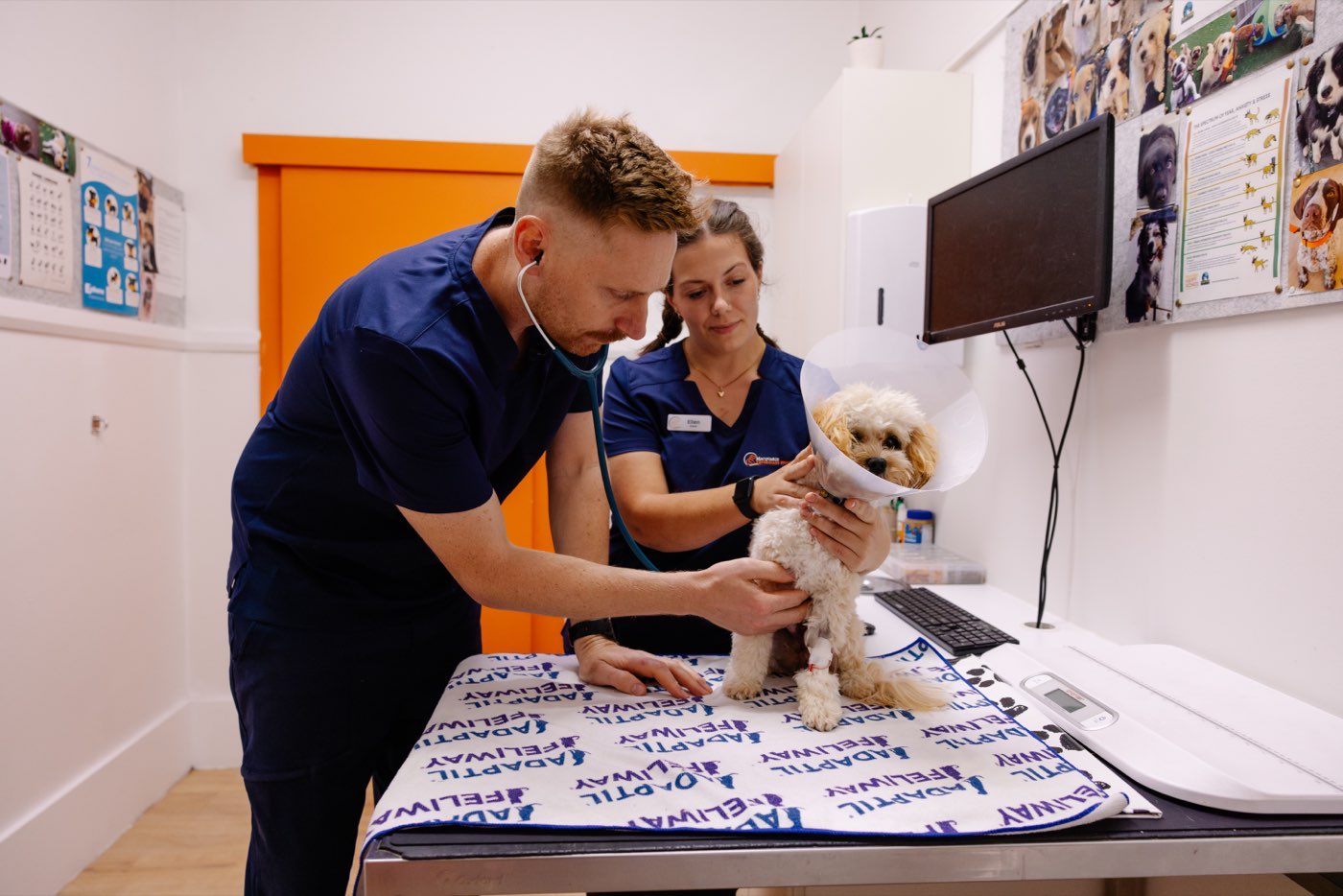
The history usually points at the answer, so we start with questions: what changed, what they might have eaten, how long it has been going, whether they are drinking, and where worming is up to. Then we examine your dog, feel the belly gently and check how dehydrated they are, and we will explain what we are finding as we go.
A stool sample is worth bringing if you can. It lets us see what the diarrhoea actually looks like, and check for parasites without asking you to come back a second time.
Many dogs go home the same day with a diet and something to settle things. Where the picture suggests a blockage, Macquarie Veterinary Hospital has x-ray and ultrasound on site, so we can look rather than guess.
Macquarie Veterinary Hospital also keeps room in the day for urgent cases, so we can see a dog who has gone downhill.
The plan we send you home with is built around your own dog. We will tell you what to look out for and when to ring back, and we will follow it through with you until the stool is normal again.
Common questions
Should I starve my dog for 24 hours?
For a mild case in a healthy adult dog, resting the gut for 12 to 24 hours before starting bland food is reasonable. Water stays available the whole time. If your dog is a puppy, very small, elderly or unwell in any other way, please give us a ring before you hold any food back.
Can I give my dog an anti-diarrhoeal from the chemist?
Please do not. Human medicines are a common cause of poisoning in dogs, dose matters enormously at dog size, and stopping the gut moving is exactly the wrong move if the problem is a blockage or a toxin. A quick call to us costs nothing and we are happy to take it.
My dog has diarrhoea but is completely happy in himself. Do I still need a vet?
Not necessarily on day one. That is the classic mild case and it usually settles on its own. Plain food, water kept up and a quiet eye on them is plenty for now, and we would want to hear from you if it is still going at the two to three day mark or if anything else changes.
Is it worms?
It might be, and a stool sample answers it. Worms can also cause diarrhoea with no other sign at all, which is why routine prevention matters more than treating when you see something, and we are happy to go through what your dog needs.
What if the problem is the opposite and nothing is coming out?
Straining and passing little or nothing is a different problem with a different set of causes, and some of them are urgent, so please give us a ring if that is what you are seeing.
What next?
If you are trying to work out whether anything at all is an emergency, start with when to rush to the emergency vet. For the rest of the gut, see throwing up white foam.
References
Our approach to acute diarrhoea follows current Australian and international veterinary guidance, including RSPCA Australia and the European antimicrobial-stewardship recommendations.
- Cornell University College of Veterinary Medicine, Richard P. Riney Canine Health Center: Diarrhea. Its 48 to 72 hour threshold (we would rather see your dog at 48), that most cases are mild and self-limiting, the bland diet and its limits, black stool as digested blood, and bringing a stool sample. Quoted there to Dr Meredith Miller, associate clinical professor of small animal medicine. Checked 31 July 2026.
- O'Neill DG, Prisk LJ, Brodbelt DC, Church DB. Epidemiology and clinical management of acute diarrhoea in dogs under primary veterinary care in the UK. PLoS One 2025;20(6):e0324203. A VetCompass study of 2,250,417 dogs: one in twelve diagnosed a year, over 80% needing only one visit, the signs that travel with diarrhoea, and the ENOVAT recommendation against routine antibiotics. UK primary-care data.
- RSPCA Australia Knowledgebase: What is canine parvovirus? Australian case numbers, the clinical picture, the ages most at risk, and reported survival with intensive treatment. Updated 12 November 2025.
- RSPCA Australia Knowledgebase: What are common household dangers for pets? Cooked bones and obstruction, and the Australian Animal Poisons Helpline. Updated 18 December 2023.
- Cornell Riney Canine Health Center: Whipworms in dogs. That worms can cause soft stool or diarrhoea with blood or mucus, and can also cause no signs at all.
Updated November 2026. General information, and it cannot replace someone examining your dog. If you are unsure about anything here, we would much rather you rang us and asked: that is what the phone is for.
Absolutely amazing service. Very knowledgeable vets and lovely reception staff. My hyperactive 6yo border collie had TPLO surgery in March, and despite her best efforts to break out of her enclosure, eat her bandages and sabotage their work Dr Michael and Dr Matt are amazing with her and with reassuring us that everything will be OK. Highly recommend this clinic.
Tearna Lancaster, Google review · 5 stars
A real review, quoted as written. Read our Google reviews →
Medically reviewed by Dr Michael Stephen, BVSc, MVSc.
Not settling? Come and see us
A stool sample helps if you can bring one, and it helps us to know what changed. Most dogs go home the same day with a plan. During opening hours we are on 02 9888 1833, and outside them our after-hours emergency partner, listed in the footer is there when we are not.
Book an appointment →